
Duivelsgrot cave
A former marl quarry on the Mount Saint Peter, which owes its name to a centuries-old folk tale.



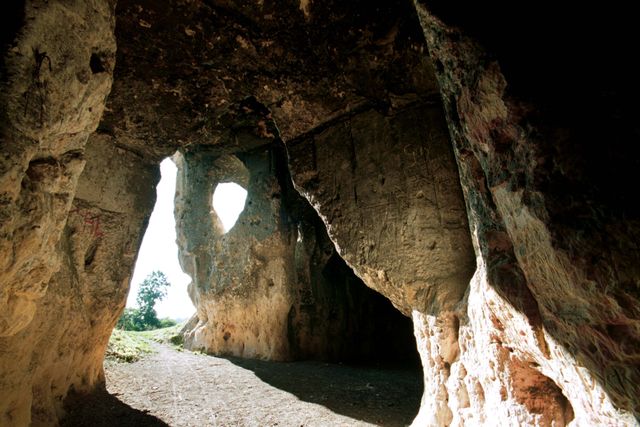

On the western side of the Mount Saint Peter lies the Devil’s Cave. Historically, this site is known as the Wijngaardgroeve. Unlike the extensive network of passages in Grotten Noord and Grotten Zonneberg , the Duivelsgrot Cave consists of a relatively small cavity in the marl cliff. Today, the Duivelsgrot Cave serves as a reminder of the centuries-long marl quarrying on Mount Saint Peter.
Not actually a cave
Despite its name, the Devil’s Cave is not actually a cave, but a former marl quarry. The quarry was dug out by people at a spot where the marl lay close to the surface. The extracted marl was used for centuries as a building material in Maastricht and the surrounding area.
The steep marl cliffs still clearly show how limestone used to be quarried here.
Where does the name come from?
According to a well-known explanation, the Devil’s Cave owes its name to the two large openings in the marl wall. Together, they are said to resemble the eyes of a devil, which is why the place has captured the imagination for centuries.
The former marl quarry is situated in the Sint Pietersberg & Jekerdal Natura 2000 area, a European protected nature reserve. The Devil’s Cave is closed to protect the natural environment and due to the risk of collapse. As a result, the cave is not accessible to visitors.
Discover the surroundings
Tips in the area
Skip map elements